
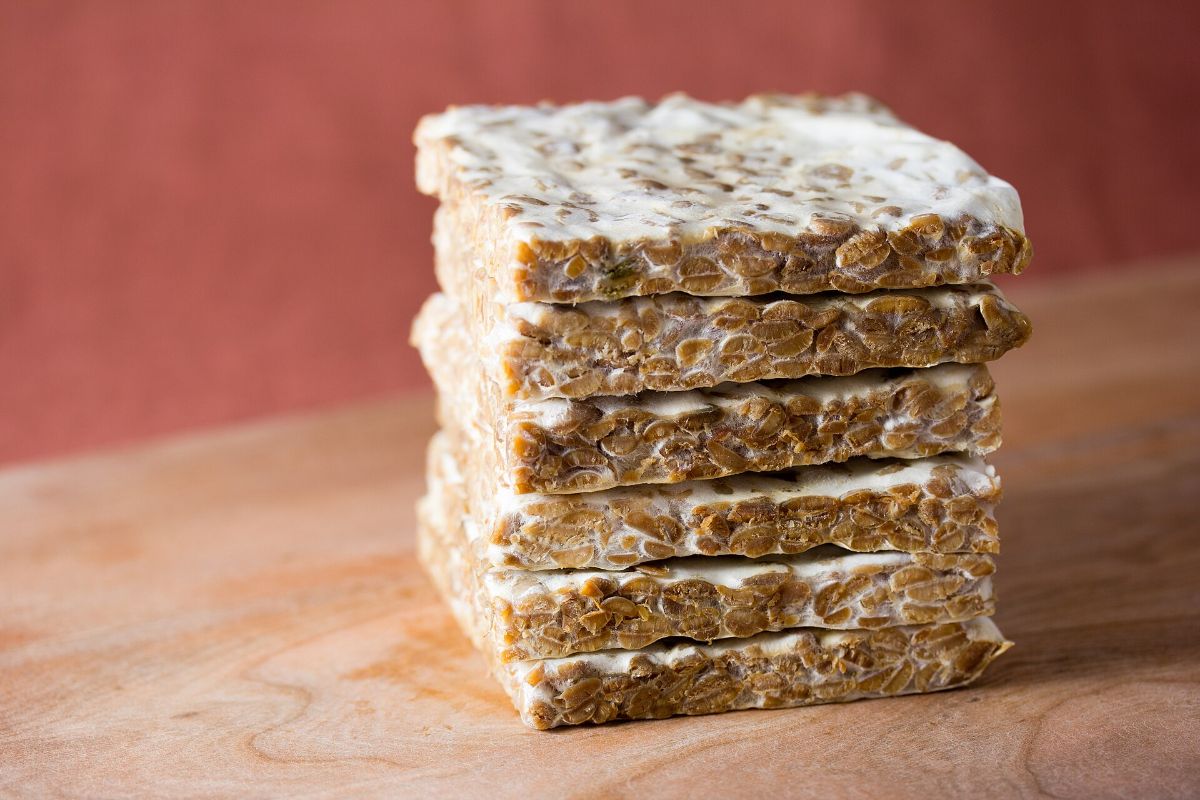
Tempeh is a firm, sliceable cake of beans knitted together by a white mould. It comes from Java in Indonesia, where it has been made for centuries, and it has become a staple of plant-based kitchens around the world. Making it yourself is surprisingly simple once you understand what the mould needs: cooked, slightly acidic, well-drained beans, air, and a steady warm temperature for one to two days. This guide walks you through ingredients, method, incubation, troubleshooting and the food safety rules that matter most.
What is tempeh and which fungus makes it?
Tempeh is made by solid-state fermentation: the mould grows on and between moist, cooked beans rather than in a liquid. The fungi used are species of Rhizopus, mainly Rhizopus microsporus var. oligosporus (often sold as Rhizopus oligosporus) and Rhizopus oryzae. Their hyphae grow through the bean mass in about a day, binding it into a solid cake, while their enzymes break down part of the protein and fat. The result has a mild, nutty, slightly mushroom-like flavour and a firm texture.
Tempeh belongs to a large family of fungal foods made around the world, from koji in Japan to oncom in West Java. Our course Traditional Fungal Ferments of the World explores that diversity, and Solid-State Fermentation for Food Innovation explains the process engineering behind it.
Ingredients and equipment
| Item | Why it matters |
|---|---|
| Dried soybeans, ideally dehulled | The mould cannot penetrate intact hulls well. Split, dehulled beans give the most even result. |
| Tempeh starter | Spores of Rhizopus, usually mixed with rice flour. Buy from a reputable supplier and follow its dosage. |
| Vinegar | Slightly lowers the pH of the beans, which discourages spoilage bacteria. |
| Perforated bags or trays | The mould needs oxygen. Zip bags pricked every couple of centimetres, or shallow trays covered with perforated foil, work well. Banana leaves are traditional. |
| Incubator and thermometer | An oven with only the light on, a proofing box, or an insulated box with a thermostat-controlled heat mat. A probe thermometer lets you check the core of the cake. |
Once you are confident with soy, you can try chickpeas, lentils, fava beans, lupins or mixtures with grains such as barley or oats. Each behaves slightly differently, so change one variable at a time.
Step by step: making your first batch
- Soak. Soak the beans overnight in plenty of water.
- Dehull. Rub the soaked beans between your hands to split them and loosen the hulls, then float the hulls away with water. Buying pre-split beans saves time.
- Cook. Boil the beans until tender but not mushy, usually somewhere between 30 minutes and an hour depending on the bean. Add a splash of vinegar to the cooking water or to the drained beans.
- Dry. This step is critical. Drain thoroughly and spread the beans on a clean towel or tray, or stir them in the warm pot so the steam evaporates. The surface should feel dry, not wet.
- Cool and inoculate. Let the beans cool to roughly body temperature. If they are too hot, you can kill the spores. Sprinkle the starter over them and mix very thoroughly so every bean is coated.
- Pack. Fill the perforated bags or trays to a layer of about two to three centimetres and press lightly. An even thickness gives even growth.
- Incubate. Keep at around 30 to 32 degrees Celsius. After 12 to 24 hours you will see white growth and condensation; after 24 to 48 hours the cake should be firm and fully white.
- Cool down and store. Remove from the incubator, let it cool, then refrigerate. Steam or fry the tempeh before eating.
If you plan to make tempeh regularly or even sell it, the professional workflow, from bean preparation to packaging, is covered in Tempeh Production.
Getting the incubation temperature right
Temperature control is where most first batches succeed or fail. Rhizopus grows best at around 30 to 32 degrees Celsius. Below roughly 25 degrees, growth is slow and other microbes get a head start. Two practical points make a big difference:
- The ferment heats itself. In the first hours you need to add warmth. Once the mould is growing vigorously, usually after 12 to 18 hours, it produces its own heat and the core can become several degrees warmer than the air around it. At this stage turn the heat down or off and give the bags more space.
- Too hot is as bad as too cold. If the core gets much hotter than about 40 degrees Celsius, the mould struggles and bacteria take over, which leads to slime and ammonia. Measure the core, not just the air.
Air matters too. The mould needs oxygen, but too much airflow dries the surface. Perforated bags strike that balance; a sealed container without holes will fail.
Troubleshooting
| Problem | Likely cause | What to do |
|---|---|---|
| No growth after 24 hours | Inactive starter, beans too hot when inoculated, incubation too cold | Discard. Next time check starter age, cool beans properly and verify the temperature. |
| Patchy growth, loose beans | Uneven mixing, wet spots or too little air | Mix the starter more thoroughly, dry the beans better, add more holes. |
| Black or grey patches, often near holes | Sporulation, a normal part of the Rhizopus life cycle | Safe if the cake is firm and smells pleasant. Shorten incubation if you prefer it white. |
| Strong ammonia smell | Over-fermentation, too warm or too long | A faint note is common; a sharp smell means it went too far. Discard if it is also slimy. |
| Slimy, wet or sour-smelling | Bacterial contamination, usually from wet beans or overheating | Discard. |
| Pink, yellow, green or blue moulds | Contaminating fungi or bacteria | Discard the whole batch. Do not cut away and eat the rest. |
Food safety essentials
Tempeh has a good safety record when made correctly, but you are deliberately growing a microorganism on a nutrient-rich food at a warm temperature. These rules protect you:
- Use a known starter. Never rely on spontaneous fermentation or unidentified moulds.
- Keep everything clean. Wash hands, bowls and spoons well. Use fresh bags or clean, dry trays.
- Dry and acidify the beans. Wet beans are the most common cause of bacterial spoilage.
- When in doubt, throw it out. Off colours, slime or a foul smell mean the batch is lost.
- Cook before eating. Steam, simmer or fry tempeh rather than eating it raw.
- Do not ferment coconut or maize this way at home. A traditional Indonesian coconut-based product, tempe bongkrek, has caused fatal poisonings. They are linked to bongkrekic acid, a heat-stable toxin produced by the bacterium Burkholderia gladioli pathovar cocovenenans, which can also contaminate fermented maize products. Its production has been banned in Indonesia since 1988.
- Respect the spores. Avoid breathing in starter powder and let sporulating cultures stay in the kitchen, not in bedrooms. Rhizopus species can rarely cause serious infections in people with severely weakened immune systems; anyone in that situation should talk to their doctor before handling mould cultures.
Fresh tempeh keeps for a few days in the refrigerator. For longer storage, steam or blanch it briefly, cool it and freeze it. For a structured approach to hazards, critical control points and contamination, see Fungal Food Safety in Fermentation and Food Microbiology of Yeasts and Moulds.
Tempeh in the UK: beans, climate and rules
British tempeh makers have shown that the method works well beyond soya.
- Home-grown pulses. Fava beans (field beans) and peas are grown widely in the UK and can be used alone or mixed with soya. Dehull or crack thick-skinned beans so the mould can penetrate.
- Incubation. Most British kitchens are too cool for tempeh for much of the year, so a thermostatically controlled heat source is essential. Watch the core temperature once the tempeh starts generating its own heat.
- Selling tempeh. Any food business must register with its local authority at least 28 days before trading. Registration is free and can't be refused. You also need food safety procedures based on HACCP principles, and the Food Standards Agency publishes guidance for small producers.
- Labelling. Prepacked tempeh must follow UK food labelling rules, with soya and any cereals containing gluten emphasised as allergens in the ingredients list.
Take your fermentation further
Tempeh is an ideal entry point into fungal fermentation: quick, visual and endlessly adaptable. The School of Fungal Fermentation and Food Science teaches live online courses on tempeh, koji and other mould ferments, while the School of Culinary Mycology and Foraging shows how to cook with them. To build a solid professional foundation, explore the Diploma in Artisan Fungal Fermented Foods at Fungaris.
