Never eat a wild mushroom identified only from a website, a book or an app. Have every find checked in person by an expert, such as a mycological society.
Identification
The jack-o'-lantern mushroom is a large, fleshy, bright orange mushroom that grows in dense clusters with stems fused at the base. The cap is convex, later flattened to funnel-shaped, often with a small central bump, and its colour ranges from bright orange to reddish or brownish orange. The underside has true, crowded, knife-edged gills that run far down the stem. In complete darkness, fresh gills give off a faint greenish bioluminescent glow, which needs dark-adapted eyes to see. The stem is tough, orange to brownish and often off-centre. The spore print is white to pale cream, and the flesh is orange throughout.
Related species include Omphalotus illudens in eastern North America, O. olivascens in western North America and O. japonicus in East Asia, all of which are poisonous.
Habitat and ecology
Omphalotus olearius is a wood-decay fungus, mostly a saprotroph and sometimes a weak parasite, that grows on stumps, roots and the base of living or dead broadleaf trees. It is most famous on olive trees, which gave it its Latin name, but is also common on oaks, chestnut and other hardwoods. Clusters often seem to rise from the soil when they grow from buried roots. It is widespread in the Mediterranean region and occurs more rarely in warmer parts of central Europe, fruiting from late summer to late autumn.
Uses and importance
This species has no food use. Its toxicity is attributed mainly to illudins (illudin S and M), sesquiterpenes that damage DNA and cause intense irritation of the digestive tract. These same compounds attracted cancer researchers: a semi-synthetic derivative of illudin S, irofulven, has been tested in clinical trials as an anticancer agent, which does not make the mushroom itself medicinal or safe. Its bioluminescence, a property shared with honey fungus and several other wood-decay fungi, is studied as part of research into the fungal light-emitting pathway.
Safety and edibility
Poisonous. Symptoms usually start 30 minutes to 3 hours after eating, with repeated vomiting, diarrhoea, abdominal cramps, sweating and weakness. Most people recover within a day or two, but severe fluid loss can be dangerous, particularly for children, older people and those with other illnesses. No preparation makes it safe to eat.
If anyone may have eaten this mushroom, seek medical help immediately, and bring leftovers or photos. Because mixed collections are common, any symptoms after a meal of wild mushrooms need medical assessment: a jack-o'-lantern may not be the only species in the basket.
If you suspect mushroom poisoning, call 999 in an emergency or NHS 111 for urgent advice straight away, even before symptoms appear, and keep the remains of the mushrooms.
Look-alikes
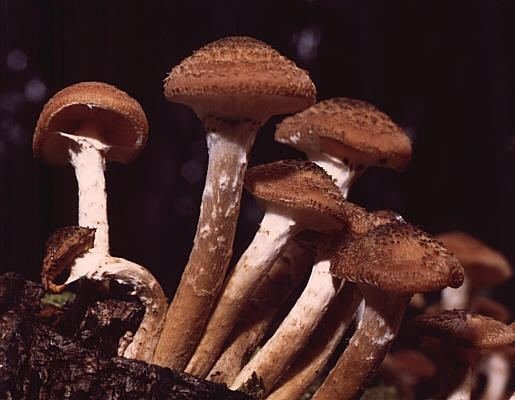
The main confusion is with the chanterelle (Cantharellus cibarius). Chanterelles grow singly or scattered on the ground, not in fused clusters on wood, have blunt, forked, vein-like ridges instead of sharp, crowded gills, and have whitish to pale yellow inner flesh rather than orange throughout. The false chanterelle (Hygrophoropsis aurantiaca) is smaller, with soft, repeatedly forked orange gills. Honey fungus (Armillaria) also grows in clusters on wood but is honey-brown with a ring. Pale, brownish forms have occasionally been confused with oyster mushrooms (Pleurotus ostreatus), which are grey to brown, softer and have no orange colour.
In the UK
The jack o' lantern is occasionally reported from Britain but is not yet authenticated as a British species in the British Mycological Society's checklist. It is a species of southern Europe, growing in clusters at the base of olive trees, oaks and other broadleaved trees.
British foragers are most likely to meet it on holidays in the Mediterranean, where it is mistaken for chanterelles. Unlike chanterelles it grows in clusters on wood and has true, sharp gills. It causes severe vomiting and diarrhoea.