
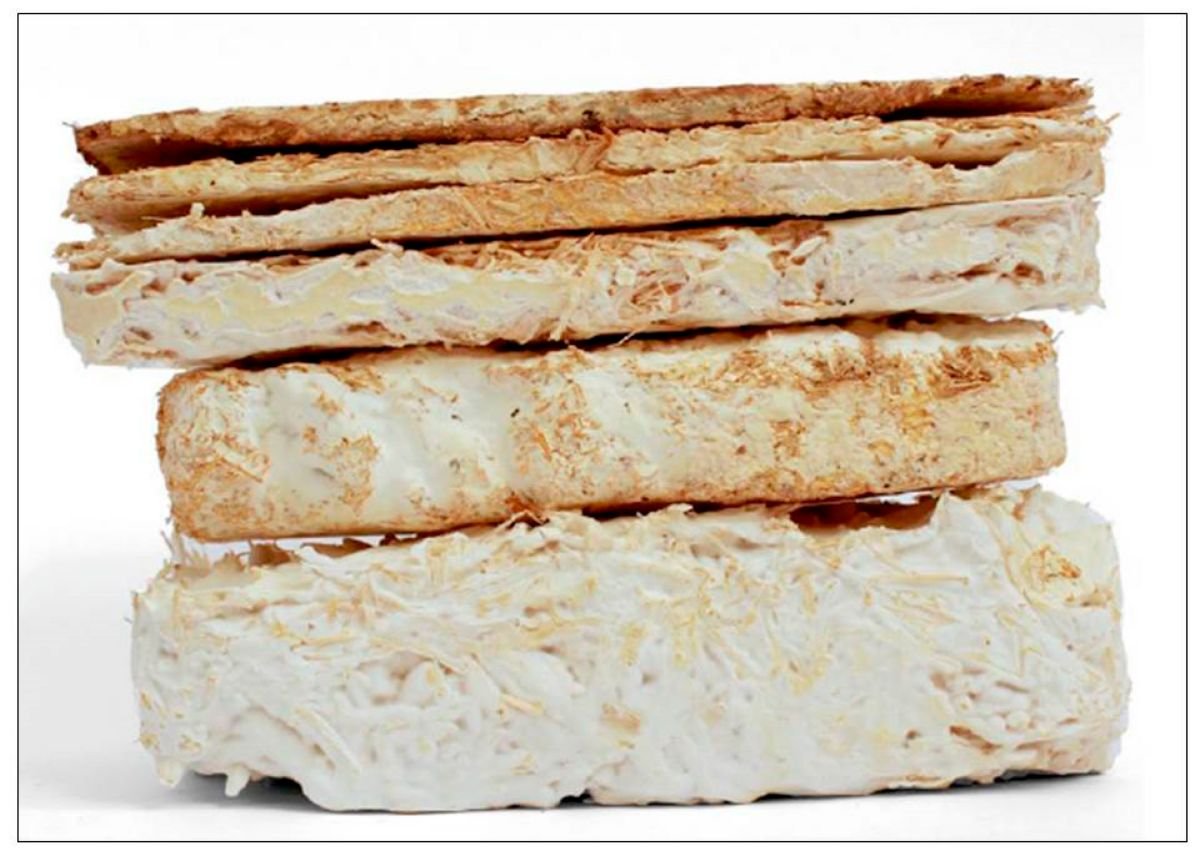
Mycelium materials have moved from art-school experiments to products you can actually buy: protective packaging that can be composted, acoustic panels on office walls and leather-like sheets used by fashion brands. Behind all of them sits the same idea. Instead of melting, molding or weaving a material, you let a fungus grow it. This guide explains what mycelium materials are, how they are made, where they work well, where they fall short and where the industry seems to be heading.
What are mycelium materials?
Mycelium is the vegetative body of a fungus: a dense network of microscopic threads called hyphae that spreads through soil, wood or any suitable food source. Hyphal walls are built largely from chitin, glucans and proteins, which makes them tough yet light. When mycelium colonizes loose particles such as straw or wood chips, it binds them into a solid mass and acts as a natural glue.
The term mycelium materials covers two broad families:
- Mycelium composites: agricultural or forestry residues bound together by fungal growth. They are used for packaging, insulation, acoustic panels, furniture and design objects.
- Pure or nearly pure mycelium: mats or sheets of fungal tissue grown on the surface of a substrate or in liquid culture, then processed into leather-like materials, foams or textiles.
Most producers work with fast-growing wood-decay fungi, especially white-rot species from genera such as Ganoderma, Pleurotus and Trametes. The strain strongly influences density, color, growth speed and final mechanical properties, which is why strain selection is a core skill in fungal biotechnology.
How mycelium materials are grown
Every company has its own protocols, but the basic process for composites is similar everywhere:
- Substrate preparation. A lignocellulosic residue such as hemp hurd, cereal straw, sawdust, corn stalks or cotton waste is chopped, moistened and pasteurized or sterilized to reduce competing microbes.
- Inoculation. Grain spawn or liquid culture of the chosen fungus is mixed into the substrate under clean conditions.
- Growth in molds. The mix is packed into molds or trays. Over several days the hyphae colonize the particles and knit them together, taking on the shape of the mold.
- Demoulding and skin formation. Many processes remove the part from the mold and let it grow a little longer so that a protective skin of mycelium forms on the surface.
- Inactivation and drying. Heat treatment stops growth and dries the part, so the fungus cannot keep growing or produce mushrooms while the product is in use.
Leather-like materials follow a different route. Producers grow thick mycelium mats on trays of substrate or in fermentation vessels, harvest the fungal layer and then treat it in steps that resemble tanning: softening, cross-linking, dyeing, pressing and finishing. Producing a consistent, defect-free mat at commercial scale is one of the hardest problems in the field. It depends on precise control of humidity, carbon dioxide, temperature and airflow, topics covered in depth in Bioreactors & Solid-State Fermentation.
Mycelium packaging
Packaging was the first large commercial application and remains the most mature. Molded mycelium inserts can replace expanded polystyrene for protecting wine bottles, electronics, candles or cosmetics. The appeal is clear: the material is made from residues, it grows into shape without energy-intensive forming, and at the end of its life it can be broken up and composted, where local waste rules allow.
Designers do have to work within constraints. Parts are usually thicker and heavier than foam equivalents, growth cycles take days rather than seconds, and surfaces can be rough or dusty unless they are well skinned. If you want to design and produce mycelium packaging, Mycelium Biomaterials & Packaging covers substrates, mold design and process control step by step.
Mycelium leather and textiles
Mycelium leather attracted huge attention around 2020, when several luxury and sportswear brands presented prototype bags and shoes. The promise was a material with the feel of leather, grown in weeks rather than years, without animals and with a potentially smaller footprint than many synthetic leathers.
Reality has been more complicated. Some ventures paused or scaled back production after struggling to reach consistent quality at competitive cost. Raw mycelium mats are not durable enough on their own: they usually need plasticizers, binders and surface coatings, and some commercial products combine mycelium with textile backings or polymer finishes. That is not automatically a problem, but it affects biodegradability claims and should be disclosed openly.
For people working in fashion or accessories, Mycelium Leather & Textiles explains the biology and the finishing chemistry, while the School of Design looks at how designers can work with the character of the material instead of forcing it to imitate cowhide.
Mycelium in buildings: panels, insulation and bricks
Architects have experimented with grown structures for more than a decade. A well-known early example is the Hy-Fi tower, built from mycelium bricks for the MoMA PS1 Young Architects Program in New York in 2014. Since then, attention has shifted toward non-structural products that make use of the low density and porous structure of mycelium composites:
- Acoustic panels, where the open, fibrous structure absorbs sound.
- Thermal insulation boards, competing with other bio-based insulation such as wood fiber, hemp or straw.
- Interior elements such as wall tiles, partitions and furniture.
- Blocks and bricks for pavilions and research buildings, usually combined with timber or another load-bearing structure.
Construction is the most regulated application. Products must demonstrate reliable fire behavior, moisture resistance, durability and dimensional stability, and they need test data before anyone can specify them on a real project. Mycelium in Construction introduces these requirements, and Standards, Fire Safety and Certification for Mycelium Materials goes deeper into testing and approval routes.
Strengths and limits
| Strengths | Limits |
|---|---|
| Made from low-value agricultural and forestry residues | Low compressive and tensile strength compared with wood, concrete or engineered plastics |
| Grows into shape at moderate temperatures | Growth cycles of several days and sensitivity to contamination limit throughput |
| Light, with useful acoustic and thermal properties | Absorbs water unless coated or protected; can degrade in damp conditions |
| Can be compostable when no synthetic additives are used | Batch-to-batch variability makes certification harder |
| Research reports a tendency to char rather than melt in fire | Fire performance still has to be proven product by product |
The honest summary: mycelium is not a universal replacement for plastic, leather or concrete. It is an excellent material for specific jobs, especially protective packaging, interior acoustics and insulation, and it performs best when products are designed around its properties from the start. Credible environmental claims also require measurement, which is why Life Cycle Assessment for Biomaterials is a valuable companion to any production skill.
Mycelium materials in the United States
The United States has been one of the birthplaces of mycelium materials. Ecovative, founded in 2007 in Green Island, New York, by Eben Bayer and Gavin McIntyre after a project at Rensselaer Polytechnic Institute, developed mycelium-based packaging and later foams, textiles and food products. Other US start-ups have worked on mycelium leather, with mixed commercial results: some have scaled down or closed production lines, which shows how hard it is to move from prototype to industrial scale.
What to consider if you want to work in the field
- Building codes: materials used in buildings in the US must meet the building codes adopted by each state or city, which are usually based on the International Code Council's model codes. Fire performance testing is a key step for insulation, panels and interior products.
- Packaging: claims such as "compostable" or "biodegradable" must be truthful under Federal Trade Commission guidance, and some states have their own labeling laws.
- Food contact: materials intended to touch food are regulated by the FDA.
- Biosafety: work with strains and production facilities should follow good manufacturing practices and occupational health rules.
Universities, maker spaces and community labs offer places to experiment. Standards, fire testing and certification are covered in Standards, Fire Safety and Certification for Mycelium Materials.
Where the industry is going
After an early phase of hype, the sector is maturing. Several trends stand out:
- Industrialization. Producers are investing in automation, tighter process control and better strains to shorten cycle times and reduce variability.
- Hybrid materials. Combining mycelium with natural fibers, bio-based binders or timber improves performance while keeping a high share of renewable content.
- Standards and data. Buyers increasingly ask for test reports, environmental product declarations and clear end-of-life information.
- Living materials. Research groups are exploring engineered living materials that can sense, self-repair or respond to their surroundings, a field covered in Engineered Living Materials with Fungi.
The professionals this industry needs combine mycology, process engineering and design thinking.
If you want to become one of them, Fungaris offers live online programs from short courses to full qualifications. A strong place to start is the Master in Mycelium Materials Design & Manufacturing, which brings biology, manufacturing and design together in one structured path.