Never eat a wild mushroom identified only from a website, a book or an app. Have every find checked in person by an expert, such as a mycological society.
Identification
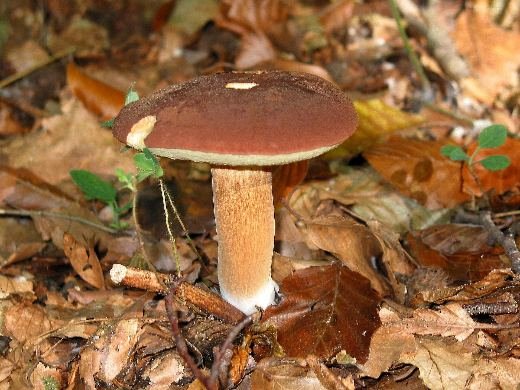
The pine bolete is a heavy, thick-fleshed porcini. Its cap is wine-red, reddish brown or mahogany, often with an uneven, slightly wrinkled or granular surface and sometimes a whitish bloom when young. In wet weather the cap can become a little tacky.
The pores are white when young, then yellowish and olive-green with age, and do not bruise blue. The flesh is white and firm and does not change color when cut; just under the cap skin it often shows a reddish zone. The stem is stout and club-shaped, whitish to pale brown with reddish-brown tones, and carries a pale raised net, mainly in the upper part.
Key characters: red to mahogany cap, reddish tints on the stem, white unchanging flesh, olive-brown spore print and mild taste. Identification in the field is helped by its association with pines, but the colors vary and some forms are close to Boletus edulis.
Habitat and ecology
Boletus pinophilus is ectomycorrhizal. It is most often associated with pines, especially Scots pine, but is also recorded with spruce, fir, beech, oak and chestnut. It is widespread in Europe, from lowland sandy pinewoods to mountain forests.
It is one of the earliest porcini of the year: in mountain pinewoods it can appear in late spring or early summer, and it fruits again in fall. Acid, sandy or rocky soils with moss and heather are typical. Like other mycorrhizal fungi it trades soil water and minerals for sugars from its host trees.
Uses and importance
The pine bolete is used exactly like other porcini: fresh in sautés, risottos and sauces, or dried, which intensifies its flavor. In trade it is usually sold mixed with Boletus edulis and other species under the name porcini or cep. Its firm flesh also makes it suitable for preserving in oil after cooking.
It cannot be cultivated. All commercial supplies come from wild harvests, so its availability depends on forest health and sustainable picking.
Safety and edibility
The pine bolete is a choice edible when correctly identified and cooked. No website or app can confirm identification: have every wild mushroom checked in person by an expert, such as a mycological society or a trained mushroom adviser.
- Dangerous or unpleasant look-alikes include Rubroboletus satanas and other red-pored boletes with blueing flesh, which cause severe gastrointestinal poisoning, and the very bitter Tylopilus felleus.
- Discard old, soft or maggot-ridden specimens; spoiled mushrooms are a common cause of food poisoning.
- Cook wild boletes thoroughly.
- Mushrooms accumulate heavy metals and radioactive cesium in some regions; avoid picking near roads or industry.
Check local rules: in Germany porcini are specially protected and may only be collected in small quantities for personal use.
If you suspect mushroom poisoning, call Poison Help at 1-800-222-1222 or 911 in an emergency straight away, even before symptoms appear, and keep the remains of the mushrooms.
Look-alikes
Boletus edulis has a paler, chestnut to brown cap without red tones and a whitish stem. Boletus aereus has a dark bronze, velvety cap and grows with oaks and chestnuts. Imleria badia (bay bolete) has a chestnut cap, yellowish pores that bruise blue and no net on the stem. Suillus species such as Suillus luteus also grow under pines but have slimy caps, yellow pores and often a ring. The bitter Tylopilus felleus has pinkish pores and a dark net.
In the United States
The pine bolete is a European species. In western North America, red-brown porcini under pines are usually other members of the porcini group, such as the spring king (Boletus rex-veris) of the Sierra Nevada and Cascades, so European names should be applied with care.
Porcini in the United States are often collected on national forests, where personal-use picking is usually allowed within limits and commercial harvest requires a permit. Rules differ from forest to forest.