Never eat a wild mushroom identified only from a website, a book or an app. Have every find checked in person by an expert, such as a mycological society.
Identification
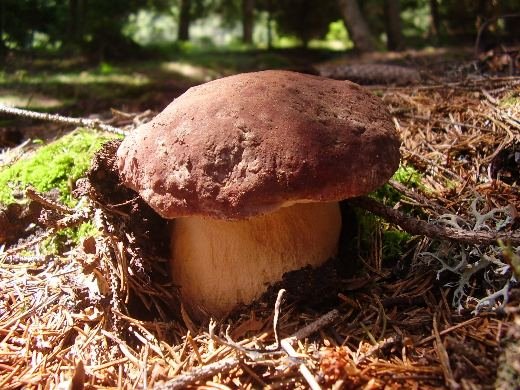
The bay bolete has a rounded cap that flattens with age, coloured deep chestnut, bay or dark brown. When dry the cap feels finely velvety; in wet weather it becomes shiny and sticky. The cap skin does not peel easily. The underside has small to medium pores, cream when young, then yellow and greenish-yellow, which turn blue to blue-green when pressed, a key difference from the penny bun group.
The stem is cylindrical, fairly slender, yellowish to pale brown and covered with brownish fibrous streaks, but it lacks the raised net (reticulum) found on Boletus edulis and its relatives. The flesh is whitish to pale lemon-yellow, firm when young, and slowly turns faintly blue above the tubes and in the stem when cut. The smell is pleasant and fruity, and the taste is mild.
The spore print is olive brown, and the spores are smooth and spindle-shaped. Molecular studies placed the species in its own genus, Imleria, which explains the change from the older names Boletus badius and Xerocomus badius still used in many field guides.
Habitat and ecology
Imleria badia is ectomycorrhizal, mainly with conifers such as spruce (Picea) and pine (Pinus), but it also grows with beech, oak and other broadleaf trees. It favours acidic, nutrient-poor soils and is often found among moss and needle litter. It fruits from late summer to the end of autumn, sometimes in large numbers, and tolerates acidified forest soils better than many other boletes.
The species is widespread in Europe and occurs in Asia; similar species in North America are now treated separately.
Uses and importance
The bay bolete is one of the most popular edible boletes in central and eastern Europe. Its firm flesh is good sautéed, in sauces and soups, dried or preserved, and many foragers rate it close to the penny bun. The blue colour that appears on cutting disappears during cooking. Insect damage is less frequent than in Boletus edulis.
The species is known for accumulating radioactive caesium (Cs-137) from the soil more strongly than many other mushrooms, which has made it a reference species in monitoring after the Chernobyl accident.
Safety and edibility
Imleria badia is edible when correctly identified and cooked. Never eat a wild mushroom based on a website or photo: have every collection confirmed in person by an expert, for example a mycological society or a trained mushroom adviser. Eat only young, firm specimens; old or mouldy boletes can cause food poisoning. As with all wild mushrooms, start with a small portion.
Blue-bruising boletes include some that cause gastrointestinal poisoning, such as Rubroboletus satanas, which has red pores and a pale cap; the bay bolete has yellow pores and a brown cap. Because of caesium accumulation, follow official advice on consumption in regions affected by fallout and avoid eating large quantities of wild mushrooms frequently.
If you suspect mushroom poisoning, call your local emergency number or poison centre straight away, even before any symptoms appear, and keep the remains of the mushrooms.
Look-alikes
Penny bun (Boletus edulis) and pine bolete (Boletus pinophilus): white raised net on a fat stem, pores white to yellow-olive that do not bruise blue. Bitter bolete (Tylopilus felleus): pinkish pores, dark net on the stem, very bitter taste. Xerocomellus chrysenteron and related species: smaller, cracked cap showing red flesh, softer texture. Xerocomus subtomentosus: olive-brown velvety cap, larger yellow pores, little or no bluing.
Around the world
The bay bolete is common across Europe in conifer and mixed forests and is widely sold at markets in central and eastern Europe. In regions where soils received fallout from the Chernobyl accident, authorities have published caesium measurements for wild mushrooms, and the bay bolete is often among the species with the higher values.