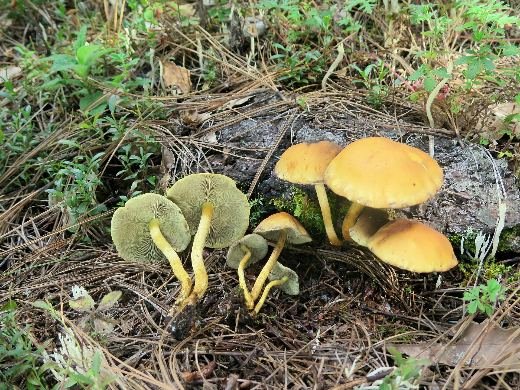
Never eat a wild mushroom identified only from a website, a book or an app. Have every find checked in person by an expert, such as a mycological society.
Identification
Sheathed woodtuft grows in dense tufts on dead wood. The cap is 2–6 cm, convex with a low umbo, and strongly hygrophanous: when wet it is a dark orange- to cinnamon-brown, and as it dries it pales from the centre to ochre, giving a typical two-toned look with a darker wet margin. The gills are attached, first pale and then cinnamon brown. The stem has a small, often fleeting membranous ring; above it the stem is smooth and pale, below it is covered with dark brown, recurved scales. The spore print is brown.
The scaly lower stem is the most important single character, but it varies with age and weather and must always be checked together with all other features.
Habitat and ecology
Kuehneromyces mutabilis is a saprotroph on dead hardwood, especially stumps of beech and birch, more rarely conifers. It is widespread in temperate Europe, Asia and North America. Fruit bodies can appear in almost any month without frost, with peaks in spring and autumn. It is one of the first colonisers of fresh stumps after felling and helps break down woody debris in forests and parks.
Microscopically, the spores are smooth with a germ pore, which helps separate it from Galerina, whose spores are roughened and lack a clear germ pore.
Uses and importance
In Central Europe the sheathed woodtuft is a traditional edible mushroom. The caps have a pleasant, spicy flavour and are used in soups and sauces; the stems are tough and usually discarded. It can be dried. The species can be grown on hardwood logs and stumps, and grow kits are sold for gardens, which is a safer way to obtain it than foraging.
Cultivation
Sheathed woodtuft is grown outdoors on freshly cut hardwood logs or stumps, especially beech or birch, inoculated with dowel or sawdust spawn. Colonisation of the wood takes many months, and fruiting starts the following year in cool, wet weather. Logs can produce for several years. Indoor cultivation is possible but uncommon. The difficulty is low, but every cluster should still be checked, as wild Galerina can also colonise logs.
Safety and edibility
Sheathed woodtuft is edible when cooked, but it is one of the most dangerous edible species to forage, because the deadly Galerina marginata (funeral bell) grows in the same habitat and looks very similar. Galerina contains amatoxins, the same toxins as the death cap. Never pick it based on a website or app: identification must be confirmed in person by an expert, such as a mycological society or trained mushroom adviser, and every single fruit body in a cluster must be checked. Amatoxin symptoms begin only 6–24 hours after eating; seek emergency help immediately if a Galerina may have been eaten, even before symptoms appear.
If you suspect mushroom poisoning, call your local emergency number or poison centre straight away, even before any symptoms appear, and keep the remains of the mushrooms.
Look-alikes
Galerina marginata has a similar hygrophanous cap, ring and brown spores, but its stem below the ring is covered with silvery-white fibres, not dark brown scales, and it often grows in smaller groups, also on conifer wood. Hypholoma fasciculare (sulphur tuft) has sulphur-yellow caps and greenish gills, a purple-black spore print and a bitter taste. Pholiota species are usually more scaly on the cap and have different colours. Because the features overlap, experts treat this species with great caution.
Around the world
The sheathed woodtuft is widespread in temperate forests worldwide and is most popular as food in Central and Eastern Europe. Mushroom advisers in many countries regularly warn about its confusion with Galerina marginata.