Never eat a wild mushroom identified only from a website, a book or an app. Have every find checked in person by an expert, such as a mycological society.
Identification
The funeral bell is a small brown mushroom of the kind often dismissed as an anonymous 'little brown job', which is exactly why it is dangerous. The cap is convex then flattened, sometimes with a low umbo, and is hygrophanous: moist caps are dark honey-brown and dry out paler from the centre, giving a two-toned look. The gills are attached, pale yellowish at first and becoming rusty brown, and the spore print is rusty brown. The stem bears a thin, membranous ring that often catches falling spores and turns brown; below the ring the stem is covered with fine silvery-white fibrils on a darker brown background, but never with upturned scales.
Microscopy helps experts: spores are almond-shaped, finely warted and have a smooth area (plage) near the base. Current taxonomy includes the former Galerina autumnalis, G. unicolor and G. venenata within G. marginata.
Habitat and ecology
The funeral bell is a saprotroph that decomposes dead wood, both of conifers and broadleaf trees. It grows singly or in small clusters on logs, stumps, buried wood, wood chips and woody debris, often among moss. It is widely distributed across the Northern Hemisphere and also recorded in Australia. Fruit bodies can appear in almost any month when it is mild and moist, with a peak in autumn, which means it can be found at the same time and on the same stumps as edible wood mushrooms.
Uses and importance
This species has no food use. Its importance lies in its toxins: it contains amatoxins (alpha- and gamma-amanitin) at levels comparable to the death cap. Amatoxins block RNA polymerase II, preventing cells from making proteins, and damage the liver above all. They are not destroyed by cooking, drying or freezing. Studies of this species have helped show how amatoxin production evolved in fungi unrelated to Amanita. Fatal and near-fatal poisonings have occurred when people collected it in the belief that it was sheathed woodtuft, honey fungus or, in some cases, hallucinogenic Psilocybe species.
Safety and edibility
Deadly poisonous. A small number of caps can be life-threatening. As with the death cap, symptoms begin after a long delay, usually 6 to 24 hours, with severe vomiting, watery diarrhoea and abdominal pain. An apparent improvement can follow while the liver is being damaged, leading to liver and sometimes kidney failure after two to four days.
If anyone may have eaten this mushroom or any unidentified small brown mushroom from wood, seek emergency medical help immediately, even before symptoms appear, and bring any leftovers or photos. No preparation makes it safe. Small brown mushrooms on wood should only be eaten if an expert has examined every single specimen in person, since one funeral bell can hide among a cluster of edible mushrooms.
If you suspect mushroom poisoning, call your local emergency number or poison centre straight away, even before any symptoms appear, and keep the remains of the mushrooms.
Look-alikes
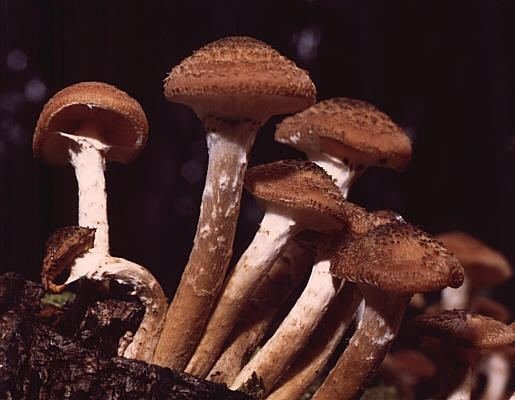
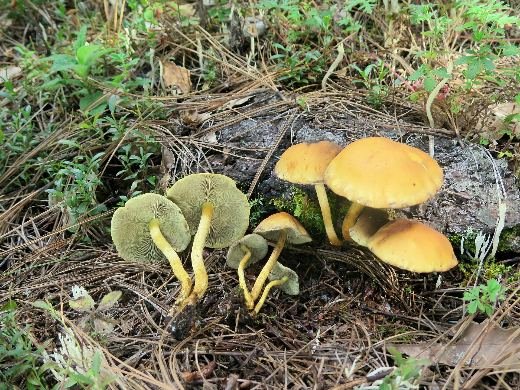
The most dangerous confusion is with sheathed woodtuft (Kuehneromyces mutabilis). Both are brown, hygrophanous, ringed and grow on wood, but sheathed woodtuft has small upturned brown scales on the stem below the ring, usually grows in larger, denser clusters on broadleaf stumps and has smooth spores with a germ pore. Wild velvet shank (Flammulina velutipes, related to cultivated F. filiformis) has a velvety dark stem, white spore print and no ring. Honey fungus (Armillaria) is larger with a white spore print. Sulphur tuft (Hypholoma fasciculare) has greenish-yellow gills and a purple-brown spore print. Psilocybe species have purple-black spores.
Around the world
Galerina marginata is one of the most widespread deadly mushrooms in the world, found across Europe, North America, northern Asia and Australia. Many guides and mycological societies advise beginners never to collect small brown gilled mushrooms from wood at all, because the margin for error is so small.