Never eat a wild mushroom identified only from a website, a book or an app. Have every find checked in person by an expert, such as a mycological society.
Identification
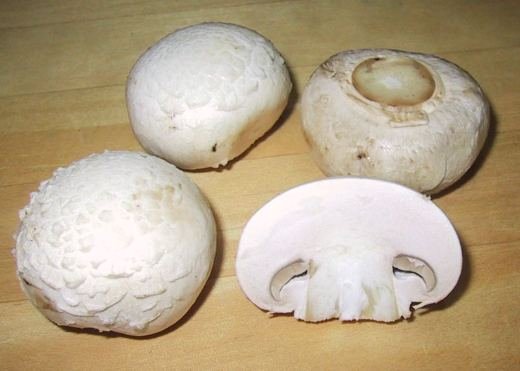
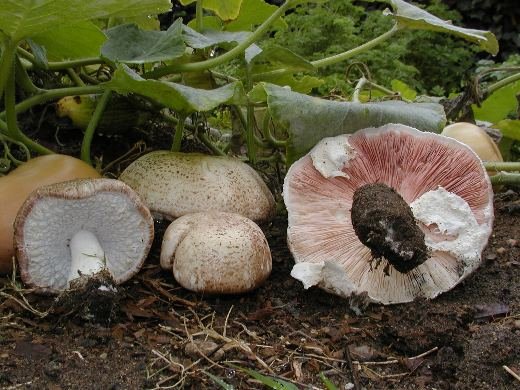
Agaricus xanthodermus is a medium to large white mushroom with free gills that are pale pink at first and turn chocolate brown as the spores mature. The cap is white to dirty white, sometimes with fine grey-brown fibrils, and in some forms becomes flattened or almost square-topped. The stem carries a broad, double-edged ring.
Two tests are central. First, scratching the cap edge or cutting the base of the stem produces an immediate, intense chrome-yellow colour that later fades to brownish. Second, the flesh, especially in the stem base, has an unpleasant smell of ink, phenol or disinfectant, which becomes stronger when the mushroom is warmed or cooked. Neither test is perfect: old or dry specimens may react weakly, and some people do not perceive the smell well, so both features should be checked together.
Related toxic species in section Xanthodermatei include Agaricus moelleri and Agaricus pilatianus, which share the phenolic smell.
Habitat and ecology
The yellow stainer is a saprotrophic fungus that decomposes organic matter in soil and leaf litter. It is typical of gardens, lawns, parks, hedgerows, roadside verges and the edges of broadleaf and mixed woods, often in nutrient-rich, disturbed ground. It fruits from summer to autumn, frequently in groups or rings, and is widespread in Europe and has been reported from North America, Australia and other regions.
Because it grows close to houses, it is often the first wild Agaricus that beginners find, which partly explains why it is involved in many poisonings.
Uses and importance
The yellow stainer has no culinary value. It matters because it is easily mistaken for edible field and horse mushrooms, and it is regularly involved in poisonings in Europe and other regions where people collect wild Agaricus.
The exact toxins are not fully characterised. Phenolic compounds, including phenol and hydroquinone, have been detected in Agaricus species of section Xanthodermatei and are thought to contribute to the smell and the irritant effect. Sensitivity varies between individuals: some people report eating it without symptoms, while others become ill, which makes informal advice especially unreliable.
In mycology teaching it is used to train foragers to check smell and staining reactions on every Agaricus they collect.
Safety and edibility
The yellow stainer is toxic and should not be eaten. Symptoms typically begin within a few hours and include nausea, vomiting, abdominal cramps, diarrhoea, sweating and headache. Most cases are not life-threatening in healthy adults, but fluid loss can be dangerous for children, older people and those with existing illness.
Anyone who has eaten it, or an unidentified white mushroom, should seek emergency medical help immediately, even before symptoms appear, and keep the remains. Remember that white mushrooms also include the deadly destroying angels.
Never rely on a website, app or photo to decide that a wild Agaricus is edible; have every find checked in person by an expert such as a mycological society or a trained mushroom adviser.
If you suspect mushroom poisoning, call your local emergency number or poison centre straight away, even before any symptoms appear, and keep the remains of the mushrooms.
Look-alikes
Edible relatives such as the button mushroom (Agaricus bisporus) and its wild forms, the field mushroom (Agaricus campestris) and the horse mushroom (Agaricus arvensis) differ in smell: field mushrooms smell mild and pleasant, and horse mushrooms and the almond mushroom (Agaricus subrufescens) smell of aniseed or almonds. Horse mushrooms may stain yellowish slowly on the cap, but the cut stem base does not turn chrome yellow. Parasols (Macrolepiota procera) have white gills and a scaly stem. The most dangerous confusion of all is with white Amanita species, which have white gills and a volva.
Around the world
The yellow stainer is widespread in Europe and occurs in North America, Australia, New Zealand and parts of Asia and Africa, often spread with garden soils and lawns. In many countries it is among the mushrooms most frequently reported in poisoning enquiries, especially in late summer when it appears in urban green spaces.