Never eat a wild mushroom identified only from a website, a book or an app. Have every find checked in person by an expert, such as a mycological society.
Identification
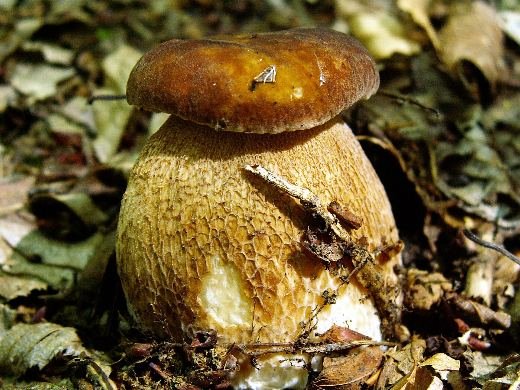
Rubroboletus satanas, formerly Boletus satanas, is one of the most massive European boletes. The cap is chalky white, pale grey or buff, sometimes with olive or pinkish tints, velvety when young and later smooth. Underneath, the pores are yellow only in very young fruit bodies and soon become blood-red to orange-red, bruising blue when pressed.
The stem is short and strongly bulbous, yellowish at the top and red to purplish-red further down, covered with a fine red net (reticulum). Cut flesh is whitish to pale yellow and turns blue slowly and rather weakly, mainly in the cap. Older specimens develop an unpleasant smell often described as carrion-like. The spore print is olive-brown.
The genus Rubroboletus was created in 2014 for red-pored boletes related to R. satanas, including Rubroboletus rhodoxanthus, Rubroboletus legaliae and Rubroboletus pulchrotinctus, which require careful study of cap colour, net and bluing reaction to separate.
Habitat and ecology
Satan's bolete is an ectomycorrhizal species of warm, open broadleaf woods, typically with oak, beech, hornbeam or lime, on calcareous soils. It favours sunny edges and slopes and fruits mainly in summer and early autumn after warm rain. It is distributed in central and southern Europe and parts of the Mediterranean region but is local and in many areas uncommon; at the northern edge of its range it is restricted to warm, lime-rich sites.
Because it depends on old trees and specific soils, it is a useful indicator of thermophilous oak and beech woodland.
Uses and importance
Satan's bolete has no culinary use. Its importance is in toxicology and identification training: it is the classic example of a red-pored bolete that must not be eaten, and its name reflects a long-standing reputation for causing violent illness.
A glycoprotein named bolesatine has been isolated from the fruit bodies and shown to be toxic in laboratory studies, but its precise role in human poisoning has not been fully established. Reported poisonings involve intense gastrointestinal symptoms, sometimes even after the mushroom has been cooked.
Its rarity in many regions also makes it of interest to field mycologists recording thermophilous fungi.
Safety and edibility
Satan's bolete is poisonous and must not be eaten, raw or cooked. Symptoms usually begin within a few hours and include severe nausea, repeated vomiting, abdominal cramps and diarrhoea, which can lead to dangerous dehydration, especially in children and older people.
Anyone who has eaten this mushroom, or a bolete with red pores that has not been reliably identified, should seek emergency medical help immediately, even before symptoms appear, and keep the remains for identification.
Red pores, a red net on the stem and blue-staining flesh are a warning combination. Some red-pored boletes are eaten in certain regions, but the group is difficult and includes several toxic species. Never rely on a website, app or photo; have every wild bolete checked in person by an expert such as a mycological society or a trained mushroom adviser.
If you suspect mushroom poisoning, call your local emergency number or poison centre straight away, even before any symptoms appear, and keep the remains of the mushrooms.
Look-alikes
From above, the pale cap can recall a porcini, such as the summer cep (Boletus reticulatus) or the bronze bolete (Boletus aereus), but those have whitish to olive-yellow pores, never red, and a whitish or brownish net on the stem. Among red-pored boletes, Rubroboletus legaliae and Rubroboletus rhodoxanthus have pinkish tones on the cap, Suillellus luridus has an orange-brown cap and a red net with a red line above the tubes, and Neoboletus erythropus has a dark brown cap and a dotted rather than netted stem.
Around the world
Satan's bolete is mainly a European species, found from southern England and Central Europe to the Mediterranean, with related red-pored species in North Africa, Asia and North America. The North American Rubroboletus eastwoodiae has sometimes been called Satan's bolete, but it is a different species.