Never eat a wild mushroom identified only from a website, a book or an app. Have every find checked in person by an expert, such as a mycological society.
Identification
The winter chanterelle is a slender, rather small mushroom that often grows in large troops. The cap is brown, dark yellowish-brown or grey-brown, thin, with a wavy margin and a depressed centre that frequently becomes perforated, opening into the hollow stem.
Underneath there are no true gills but shallow, blunt, forking ridges that run down the stem. They are yellowish at first and become greyish or lilac-grey. The stem is hollow, yellow to orange-yellow, often flattened or grooved. The flesh is thin and elastic. The spore print is white to pale cream.
The species was long called Cantharellus tubaeformis, and this name is still common. In Europe it is often accompanied by the similar, more orange Craterellus lutescens, which has an almost smooth underside.
Habitat and ecology
Craterellus tubaeformis is regarded as ectomycorrhizal, mainly with conifers such as spruce and pine, and also occurs in mixed woods. It favours damp, acid soils with abundant moss, and often grows near very rotten wood or on mossy stumps.
It fruits late: from late summer into early winter, and it tolerates light frosts. In boreal and mountain forests of Europe and North America it can be very abundant.
Uses and importance
The winter chanterelle is a very good edible with a mild, earthy flavour. It is sautéed, added to soups, sauces and stews, and dries well, retaining its aroma. Its late season makes it useful when most other edible mushrooms have finished.
It cannot be cultivated; all supplies are wild-harvested, sometimes in large quantities in Scandinavia and North America.
Safety and edibility
The winter chanterelle is a good edible when correctly identified and cooked. Because deadly species grow in the same habitat, have every wild mushroom checked in person by an expert, such as a mycological society or a trained mushroom adviser, before eating it.
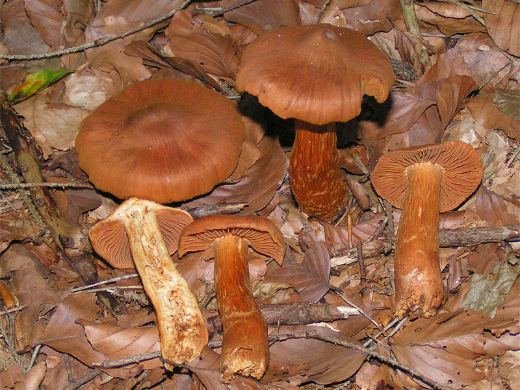
- The most serious risk is confusion with Cortinarius rubellus and other small brown webcaps. These have true gills, a solid stem and a rusty-brown spore print. Their toxin, orellanine, damages the kidneys; symptoms can start days or even weeks after the meal.
- Small brown species such as Galerina marginata, which contains deadly amatoxins, grow on mossy rotten wood in the same places.
- Check every single specimen: when large quantities are picked quickly, a toxic mushroom can easily slip in.
If a mix-up with a webcap or Galerina is suspected, seek emergency medical help immediately, even before symptoms appear.
If you suspect mushroom poisoning, call your local emergency number or poison centre straight away, even before any symptoms appear, and keep the remains of the mushrooms.
Look-alikes
The winter chanterelle has ridges, not gills, a hollow yellow stem and a white spore print. Cortinarius rubellus has a pointed orange-brown cap, true gills, a rusty spore print and a solid stem. Galerina marginata has true gills and a ring zone and grows on wood. Craterellus cornucopioides is black. Cantharellus cibarius is entirely yellow and fleshier. Craterellus lutescens has an orange cap and an almost smooth underside.
Around the world
Worldwide, the winter chanterelle is widespread in the cool forests of the Northern Hemisphere. In western North America it is commonly sold as yellowfoot, although DNA studies suggest that North American populations may include more than one species.